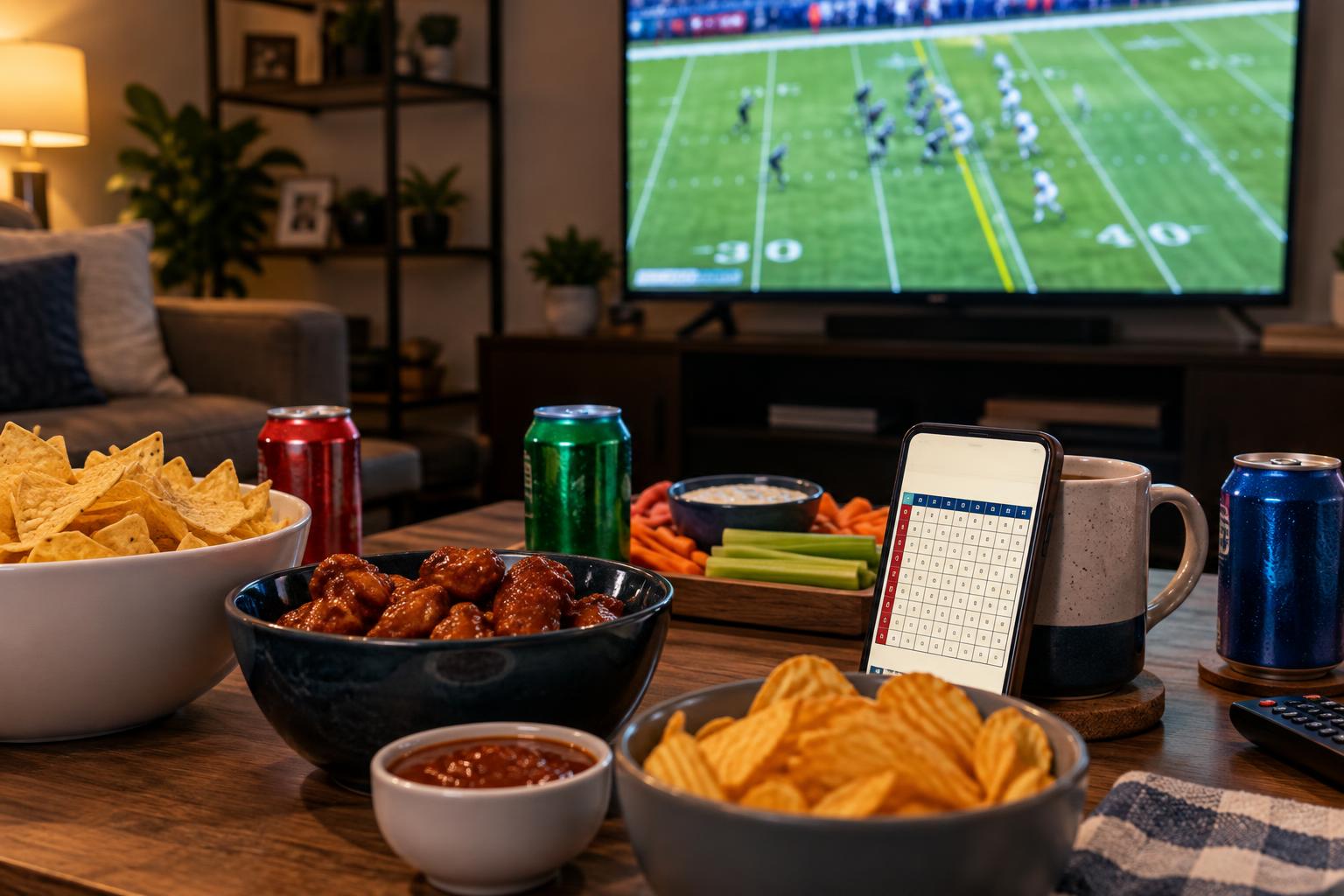
There's a reason the night games feel different. The whole league has already played by the time kickoff rolls around on Sunday night, everyone's checked their fantasy scores, and now there's one game left with nothing competing for attention. You're not half-watching the RedZone whip-around anymore. You're locked in on a single matchup, and so is everybody in your group chat. That's exactly the kind of game a squares board was built for.
Primetime football squares aren't a different product or a fancier version of the game. It's the same 10x10 grid you'd run for a Sunday afternoon kickoff. What changes is the attention. When there's only one game on and it's got a national spotlight, every scoring play lands harder, and a board full of people with bragging rights (or a snack pool) riding on the last digit of the score turns a casual watch into an event. Kansas City at Seattle drew a packed primetime slot this October for a reason, and those are the nights your board earns its keep.
Why night games are the sweet spot for squares
Afternoon slates are great, but they split the room. Somebody's watching their fantasy running back in one game while someone else is tracking a different one. A board tied to the 1 p.m. window means half the group is distracted and the other half forgets which square is theirs.
A primetime game fixes all of that. One screen, one set of numbers, one running score everybody cares about. When the quarter ends and the score lands on 7-3, the people holding that square light up and everyone else groans, and it all happens in the same room at the same time. That shared beat, every 15 minutes or so, is the entire appeal.
Thursday, Sunday, and Monday night each carry a single marquee matchup, and the NFL can flex games in and out of those slots as the season goes to protect the best ones. From a squares standpoint that's a gift. You get a game that's been curated to be watchable, which means more casual fans tuning in, which means an easier board to fill. If you've never run one before, the beginner's guide to football squares walks through the basics in about five minutes.
Set the board up the day before, not at kickoff
The biggest mistake with a night game is waiting until the pregame show to send the link. People are already settling in, food's in the oven, and nobody wants to stop and claim squares. Give yourself a runway.
For a primetime board, I like to open it up the morning of, or even the night before. That way the link can bounce around a group chat all day, the stragglers get a reminder at lunch, and by the time the broadcast starts you've got a full grid instead of a scramble. A 100-square grid wants 100 people, or a handful of people grabbing several squares each. Either works. The point is you want it full before the ball is kicked, because an empty square is a winning digit that pays out to nobody.
On PickMySquare you build the whole thing in a couple of minutes. Create a free board, pick the two teams, and share the join link. Players claim their own squares from their phones, so you're not sitting there writing names into boxes while the game's on.
Draw the numbers the right way
Here's the part that keeps a board honest: the numbers (0 through 9 along each axis) get assigned randomly, and they get assigned after every square is claimed. Not before. If the digits are visible while people are still picking, somebody's going to hold out for the 0 and 7 and the whole thing turns into a land grab.
The site handles the draw automatically once the grid is full, which means no one can accuse the host of rigging it and you don't have to pull numbers out of a hat. If you want the full breakdown of why the random draw matters and which number combinations actually hit most often, the football squares strategy guide gets into the weeds on that. Short version: 0, 7, and 3 are the digits you want, and there's nothing you can do to get them, which is the whole point.
Payouts that keep the night alive
A primetime game runs long. Three-plus hours if it's close, and you want people invested the entire time, not just at the final whistle. The fix is paying out every quarter instead of only at the end.
Four payouts (end of the first, halftime, end of the third, and the final) spreads the drama across the whole broadcast. A square that looked dead at halftime can cash in the third quarter. It also softens the sting for everyone whose numbers never come close, because there are four chances instead of one. If there's a snack pool or a few bucks riding on it, a common split weights the final heaviest, something like 20/20/20/40, since the end-of-game score is the one everyone remembers. For a casual board with friends, equal quarters is simpler and nobody argues.
One thing worth saying plainly: PickMySquare doesn't touch money. No entry fees, no prize handling, none of it. You sort the snack pool and the Venmo among yourselves. The board just tracks squares, draws numbers, and tells you who won each quarter so there's no debate when the score lands on a weird digit at the end of the third.
Keeping a one-game crowd engaged
The flip side of a single-game night is that if your matchup turns into a blowout by the third quarter, the broadcast loses the room. Your board can carry it. Even when the game's out of hand, people still check their square every time the score ticks, because the trailing team kicking a garbage-time field goal can flip a quarter winner. That's the quiet magic of squares: the scoreboard stays interesting long after the game stops being competitive.
It also works for the casual crowd who don't follow football closely. You don't need to know the depth chart to hold the 4 and 1 and cheer for a 14-11 score. That accessibility is why squares beats a lot of more complicated pools, a point we made in why simple sometimes wins. A night game plus a squares board is about the lowest barrier to entry you can offer someone who just wants in on the fun.
Primetime Football Squares FAQ
What makes a primetime game better for squares than an afternoon game?
Focus. A night game puts the whole room on a single matchup, while afternoon slates scatter everyone across a half-dozen games at once. That means every scoring change matters to somebody watching with you instead of getting lost in the whip-around.
How many squares should a primetime board have?
A standard board is 100 squares (a 10x10 grid). You can fill it with 100 people or let a smaller group grab multiple squares each. Fill it before kickoff, because an unclaimed square can still draw a winning number and then nobody is there to collect.
When should the numbers be drawn?
Only once the grid is completely full. PickMySquare drops in the 0-9 digits at random after the last square is claimed, so nobody can choose a square based on the numbers and the host can't nudge the result.
Should I pay out every quarter or just the final?
Every quarter, for a long night game. Four payouts keep people invested through a blowout and give more squares a chance to cash. Weighting the final heaviest (like 20/20/20/40) is a popular split if there's a snack pool in the mix.
Does PickMySquare handle the money?
No. The site runs the grid, draws the numbers, and marks the winners. The snack pool and any payouts are entirely between you and your players.
Can I run squares for Thursday and Monday night games too?
Yes. Any game with a running score works, so Thursday Night Football, Sunday Night Football, and Monday Night Football all make great boards. Each primetime slot is a single featured matchup, which is ideal for a one-board night.
Build Your Primetime Board in Two Minutes
Grab the two teams, share the link, and let your group claim squares from their phones before kickoff. Numbers draw automatically once the grid fills up.
Create Free Board →