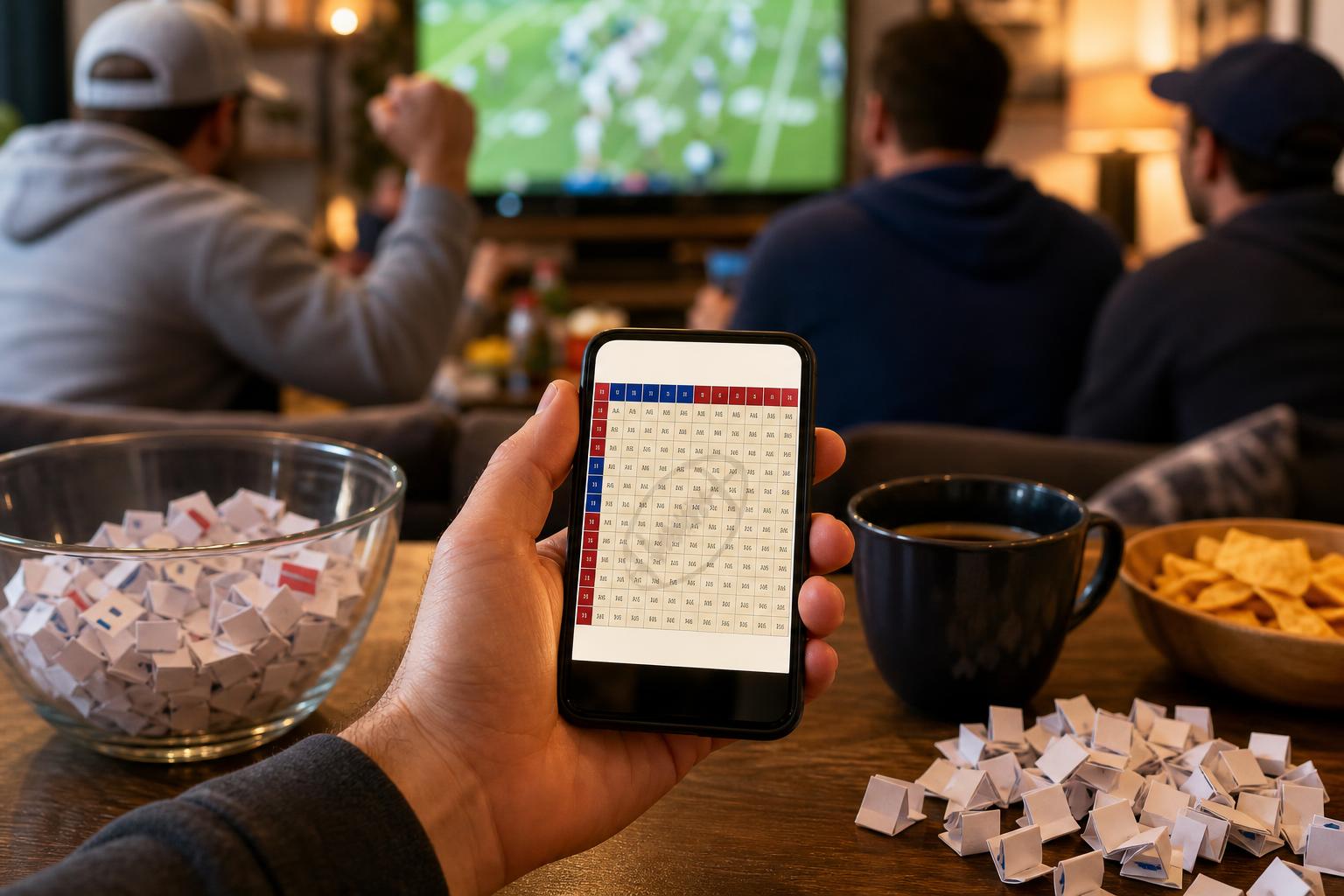
Somebody in your group chat said "let's do a raffle board for the game," everyone thumbs-upped it, and now it's your job to actually build the thing. A grid of 100 numbers, people claim the ones they want, you draw a winner. Simple idea. The build is where people get stuck, usually somewhere between the third crooked row of Sharpie numbers and realizing they have no idea how they're going to track who claimed which square. If you're figuring out how to make a raffle board and getting stuck exactly there, you're in the right place.
There are three honest ways to do this, and they are not equally good. I'll walk through all three, tell you where each one falls apart, and flag the one numbering trick that trips up almost everyone the first time.
First, what a raffle board actually is
A raffle board is a grid of numbered spaces, usually 1 through 100, laid out 10 by 10. People claim a space (buy one for a fundraiser, or grab one for free if you're just doing it for fun), and their name goes in the square. When it's time, you draw a number. Whoever's name is on that square wins.
It's the cousin of a football squares board, except squares boards tie winners to the last digit of each team's score, and a raffle board is a straight random draw. No game required. You can run a raffle board for a fundraiser, an office prize, a door prize at a party, a "guess the number" for a gift basket. The mechanic is the same no matter what the prize is.
Route 1: Poster board and a Sharpie
The classic. Grab a piece of poster board, draw a 10 by 10 grid, number the squares 1 to 100, and pin it up somewhere people walk past.
It works, and there's something nice about a physical board on the breakroom wall that people actually stop and look at. For a small in-person crowd, this is genuinely fine.
Here's where it gets annoying. You're the one standing there with the marker every time someone wants a square. You have to keep track of who's in for which one, all by memory or a scrap of paper. If two people want number 42, you're refereeing. If the board's at the office and half your group is remote, they're just out. And when it's time to draw, you're pulling numbers out of a hat or spinning a random number generator on your phone and hoping nobody accuses you of rigging it.
The board also can't do the one thing you most want it to do: tell you which numbers are still open at a glance without you squinting at the wall from across the room.
Route 2: A spreadsheet or a Canva template
Step up from poster board and you land here. A Google Sheet with a 10 by 10 grid, or a Canva template you found in a Facebook group, filled in with names.
This is better in real ways. You can share a link, people can see it from anywhere, and you're not hand-drawing anything. Canva makes it look sharp, which matters if it's for a fundraiser and you want people to take it seriously.
The catch is that a spreadsheet doesn't know it's a raffle board. It's a grid of cells that happens to have numbers in it. Nothing stops two people from typing their name in the same square. Nothing tracks who's claimed what. Nothing draws the winner for you or proves the draw was fair. You're still doing all the bookkeeping by hand, you've just moved it into a nicer-looking grid. And every edit is a chance for someone to overwrite somebody else's claim, which you won't notice until the draw when two people both think they own number 17.
Canva templates have the same problem dressed up better. Gorgeous board, zero logic behind it.
Route 3: An interactive board that tracks claims and draws for you
This is the one I'd actually build, and yes, it's the thing we make, so read this with that in mind. A raffle board on PickMySquare is a real 100-square grid where people claim their own numbers from their phone. When someone takes a square, it locks. Nobody double-claims. You can see who's in and who still owes at a glance, and when it's time, the site does the random draw for you, so there's no "how do we know you didn't pick your own square" argument.
Names go right in the squares, which covers the thing a lot of people are searching for: a raffle board with names in the squares that updates itself instead of you retyping it every time someone new joins. It's free to set up, and you can share it with a link, so your remote coworkers and out-of-town relatives are in the same board as the people standing at the wall.
The tradeoff is honest: it lives online, so if your whole group is in one room with spotty wifi and nobody wants to pull out a phone, the poster board wins that specific moment. For basically every other situation, having the board handle claims and the draw is the difference between running a raffle and babysitting one.
The numbering gotcha nobody warns you about
You said 1 to 100, and a 10 by 10 grid gives you exactly 100 spaces. One number per square. Clean.
Then somebody decides the board's too big, or they want to keep the price per square low, so they ask for 50 squares. Or 25. This is where it breaks.
Fifty squares can't hold the numbers 1 to 100 one-per-square. There aren't enough squares. So either you renumber the raffle 1 to 50 (fine, just say so up front), or each square has to cover two numbers, and now you're drawing from 1 to 100 but mapping the result back to a square that owns two of them. A 25-square board means each square owns four numbers. That's not wrong, but you have to decide it before people start claiming, and you have to make the mapping obvious, or the draw turns into an argument.
The rule of thumb: your number range should either match your square count exactly, or be a clean multiple of it. 100 numbers into 100, 50, 25, 20, or 10 squares all divide evenly. 100 numbers into 30 squares does not, and that's the board where someone ends up feeling cheated. Decide the grid size first, then the numbers, not the other way around.
Want it printed?
If you've settled on doing it on paper after all, you don't have to draw the grid yourself. We've got a printable squares grid you can print at home. Heads up on one thing: it prints landscape on standard Letter paper, so if you're outside the US and expecting A4, size it in your printer settings before you hit print.
For the fundraiser crowd specifically, a tracked board saves you the worst part, which is chasing down who still owes. There's a whole rundown in our sports fundraiser ideas guide if that's why you're here.
Raffle Board FAQ
How do I make a raffle board with numbers 1 to 100?
Draw or generate a 10 by 10 grid, that's 100 spaces, and number each one 1 through 100. On paper you write them in; in a tool like ours the numbers are already there and people claim the ones they want.
How do I make a raffle board with 50 spaces?
Either number it 1 to 50 (one number per square) or keep the 1 to 100 range and give each of the 50 squares two numbers. Pick one and tell everyone before claiming starts, because a 50-square board with a hidden 1-to-100 mapping is where disputes come from.
Can I put names in the squares instead of just numbers?
Yes. On a physical board you write names in as people join. On an interactive board the name appears in the square automatically when someone claims it, and it updates for everyone without you retyping anything.
How do I draw the winner fairly?
On paper, pull a number from a hat or use a random number generator where people can watch. Online, the board runs the random draw itself, which settles the "did you rig it" question because you never touched the outcome.
Is a raffle board the same as football squares?
Close but not identical. A football squares board ties winners to the last digits of the game score. A raffle board is a straight random draw, no game needed, so it works for any prize.
Is it free to make one online?
Setting up a raffle board on PickMySquare is free. You build it, share the link, and people claim their squares.
Skip the poster board
Build a raffle board that tracks every claim, shows who's in and who still owes, and runs the draw for you. Free to set up, share it with a link.
Create Free Board →